New Listing vs Price Reduction: What Gets More Attention from Buyers?
You have a decision to make: list your home at a competitive price and capture the rush of a fresh listing, or go in higher and plan to reduce the price later if needed. Every seller wants to know which strategy gets more attention, brings in better offers, and leads to the fastest sale. The short answer is that a well-priced new listing wins every time. But the real answer is more nuanced. Let us look at what the data says about how buyers react to new listings versus price reductions in today's South Florida market.
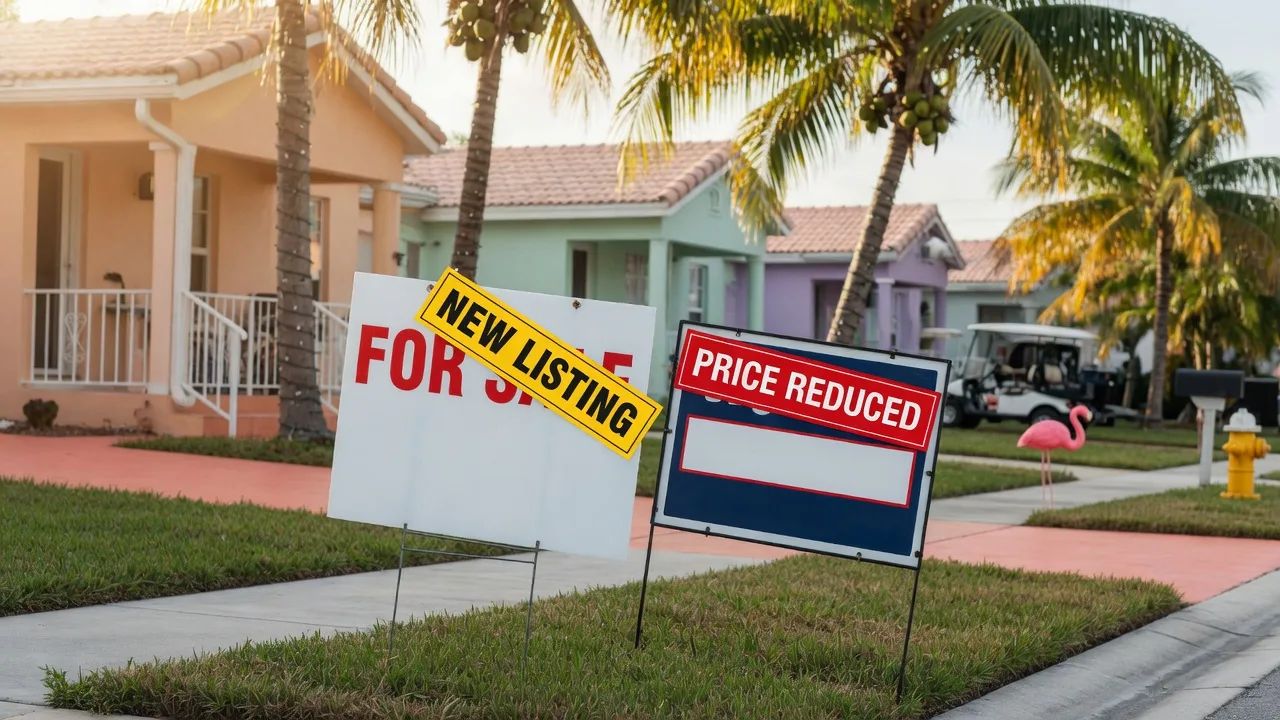
The Power of a Fresh Listing
When your home first hits the market, it gets the single biggest burst of attention it will ever receive. Buyers who search daily for new inventory see your listing immediately. Email alerts fire off. Showing requests roll in. The first 7 to 14 days on market, sometimes called the "honeymoon period," are when your home gets the most eyes and the most competition.
This is why pricing correctly from day one matters so much. If your home is priced right when it debuts, you capture the full power of that initial surge. Multiple buyers may compete for the same property, which can drive the final sale price above your listing price. In a balanced market like South Florida's mid-2026 landscape, homes that are priced competitively from the start sell faster and closer to list price than those that start high and come down.
The most recent county numbers tell the same story. In Palm Beach County's August 2026 reports, single-family sellers received a median 95% of their original list price, and condo sellers about 93%. Countywide active listings totaled 10,115 at the end of August, down 20.1% year over year. But look closer: the homes that sell fastest are almost always priced right from the start. Homes that linger past 60 days are often candidates for price reductions.
Does a Price Reduction Bring Buyers Back?
Yes, but it is a different kind of attention. When a price drops, the listing gets a "fresh" timestamp on the major real estate sites. Zillow and Redfin send notifications to buyers who have saved the property. Real estate agents see the change in their market reports. You get a second wave of interest.
However, that second wave is usually smaller and attracts a more price-sensitive buyer. The buyer who shows up after a price reduction is often looking for a deal. They know you have been on the market for a while, and they know you have dropped the price. That puts them in a stronger negotiating position from the start.
Research from Coconut Coast Realtors analyzing Florida market data shows that homes sold after a single price reduction still achieve approximately 95% to 97% of their original list price. But homes that require three or more reductions sell for a significantly lower percentage of the original ask. Each additional price cut expands the gap between the starting price and the final sale price.
As of September 2026, roughly 23% of Palm Beach County listings carried a price reduction in active-market data for August 2026, with Redfin's statewide Florida figure at about 20.6% for the same month. Look at the broader picture and a large share of Florida listings have had a cut at some point during their time on market. In Palm Beach County, single-family sellers received a median 95% of their original list price in August 2026, and condo sellers about 93%. That gap is a reminder of how much negotiating room stays on the table when a listing starts high and has to come down. If you are planning on a high list price with a reduction later, you are essentially pricing in a discount from the start and hoping buyers still bite.
For a deeper look at how pricing strategy affects your bottom line, read our guide on pricing your home to sell in South Florida.
New Listing vs Price Reduction: Side-by-Side Comparison
| Factor | New Listing (Priced Right) | Price Reduction |
|---|---|---|
| Buyer excitement | High - buyers compete for fresh inventory | Moderate - attracts deal-focused buyers |
| Negotiating leverage | Strong - you are in control | Weak - buyers know you are motivated |
| Sale price vs original list | 96%-100% of list price typical | 95%-97% after first cut, less after multiple cuts |
| Time to offer | Often within first 14 days | Depends on how long it took to reduce |
| Buyer perception | "This is the one - I need to act fast" | "Let us see how low they will go" |
| Days on market impact | Fresh listing starts the clock at zero | Higher DOM signals stale inventory |
| Showings per week (typical) | 8 to 12 in first two weeks | 3 to 6 after a reduction |
| Likelihood of multiple offers | High if priced competitively | Low - most buyers wait for further cuts |
Why New Listings Get More Attention: The Psychology
Buyers behave differently with new listings. Here is what the research and experience show:
- Scarcity mindset: A new listing triggers fear of missing out. Buyers believe someone else might snatch it first, so they act quickly.
- Curiosity: Fresh inventory is exciting. Buyers want to see what just hit the market, especially in neighborhoods they follow closely.
- Less stigma: A home that has been on the market for 60 days carries a stigma, whether fair or not. Buyers wonder what is wrong with it. A new listing has none of that baggage.
Price reductions do generate a second look, but the psychology is different. Buyers see a price drop and think "they are getting desperate" or "how much lower will they go?" This can actually slow down the sale, as buyers wait to see if the price drops further.
When a Price Reduction Makes Sense
Price reductions are not always a bad strategy. Sometimes they are the right move. Here is when a price cut works:
- The market shifted. If interest rates rose, inventory surged, or buyer demand cooled after you listed, a price reduction aligns your home with current conditions. This is smart, not a sign of failure.
- Your agent was wrong. If you listed based on a pricing strategy that did not match buyer behavior, correcting the price quickly (within 2 to 4 weeks) can reset the conversation with buyers before the listing goes stale.
- You need to sell fast. Time is more important than price. If you have a deadline and need a buyer now, a meaningful price reduction can generate activity.
- The feedback says it is overpriced. When showing agents consistently comment that the price is too high for what the home offers, it is time to listen to the market.
A note on price reduction size: Small cuts do not work. Dropping the price by $5,000 on a $500,000 home is barely noticeable. To generate real buyer attention, reductions typically need to be 3% to 5% of the list price — that is $15,000 to $25,000 on a $500,000 home. Anything less and buyers ignore it.
The Cost of Overpricing: Real Numbers for South Florida
Let us run the numbers on a realistic South Florida scenario. Say your home is worth approximately $525,000 based on recent comparable sales in Delray Beach.
- Priced right at $525,000: You get strong interest in week one, multiple showings, and an offer at or near asking within 14 to 21 days. You sell for $520,000 to $530,000 with few contingencies.
- Priced high at $560,000 (hoping to negotiate): Showings are slow in the first month. After 30 days with no offers, you reduce to $540,000. A few showings trickle in but buyers ask "why did it not sell at $560,000?" After 60 days, you reduce again to $525,000. Your home is now stale. Months on the market scare off new buyers. You eventually accept an offer around $500,000 to $510,000, roughly $15,000 to $25,000 less than what you could have gotten by pricing right from the start.
This scenario plays out every day in South Florida. The data supports it: homes with zero or one price reduction sell significantly closer to list price than homes with multiple reductions. The first price cut is often a necessary correction, but the second and third cuts signal deeper problems.
For more on the math of pricing strategy, check out our complete guide to pricing your South Florida home.
What Buyers Actually See: The Listing Lifecycle
Understanding the buyer journey helps explain why new listings outperform price reductions:
Days 1-14: The Honeymoon
Maximum exposure. Your home shows up in every search, every alert, every agent email. If the price is right, this is when offers come in.
Days 15-30: The Plateau
Showings slow down. Most serious buyers have already seen it. If you have no offers, it is time to review feedback and consider adjustments.
Days 31-60: The Stale Zone
Your listing is no longer "new." Buyers start to wonder why it has not sold. A price reduction here can reset interest, but the stigma is real.
Days 60+: The Discount Zone
Your home is now "stale inventory." Buyers expect a deal. Showings drop further. Multiple reductions signal urgency and weaken your negotiating position.
Five Tips to Avoid Needing a Price Reduction
- Use a real CMA, not an online estimate. Zillow Zestimates can be off by 10% or more in South Florida neighborhoods where block-by-block variation is high. Ryan prepares a professional Comparative Market Analysis using real sold data from the Palm Beach County and Broward County MLS. Learn how a CMA works.
- Price for the market you are in, not the one you want. As of September 2026, South Florida remains a balanced market: Palm Beach County active listings were down 20.1% year over year, but roughly 23% of listings carried a price reduction in August 2026, which means buyers have negotiating room on many homes. Pricing at the top of the range pushes buyers to the next listing.
- Invest in professional marketing. A new listing with professional photography, a cinematic walkthrough video, and a dedicated property website gets more attention than a listing with phone photos and no video. See how Ryan markets listings differently.
- Get the home ready before you list. A well-staged, decluttered, freshly painted home shows better and justifies a higher price. Read our home preparation guide.
- Be willing to delay rather than overprice. Waiting two extra weeks to list at the right price is better than listing high today and cutting the price in a month. The fresh-listing advantage is too valuable to waste.
New Listing vs Price Reduction: Frequently Asked Questions
Do new listings get more buyer attention than price reductions?
Yes. New listings receive the most buyer attention in their first 7 to 14 days on market, when they appear as "New" on Zillow, Redfin, and Realtor.com and trigger saved-search alerts. Price reductions produce a second, smaller wave of interest, but it tends to attract more price-sensitive buyers who know the home has been sitting.
How much does a price reduction hurt your sale price?
Homes with zero or one price reduction typically sell at 95% to 97% of their original list price, while homes that need three or more reductions sell for a significantly lower percentage of the starting ask. Pricing correctly up front almost always outperforms a series of incremental cuts.
What percentage of Florida listings take a price reduction?
As of September 2026, roughly 23% of Palm Beach County listings carried a price reduction in active-market data for August 2026, with Redfin's statewide Florida figure at about 20.6% for the same month. In Palm Beach County, single-family sellers received a median 95% of their original list price in August 2026, and condo sellers about 93%.
How long should I wait before reducing the price if there is no interest?
Give a fresh listing its first 14 days of full exposure, then review showing feedback around the three-week mark. If buyers consistently say the price is too high, a meaningful cut of 3% to 5% of list price resets the conversation better than two smaller drops spaced weeks apart.
The Bottom Line
A fresh, well-priced listing almost always outperforms a price reduction. The data from Florida MLS markets confirms it: homes priced correctly from day one sell faster, at higher prices, and with fewer contingencies than homes that require one or more price cuts. The fresh-listing advantage is the single best asset you have as a seller, and overpricing squanders it.
If your home is already on the market and not getting traction, a well-timed, meaningful price reduction can still generate interest. But the goal is to get it right the first time so you never need that second chance.
For more resources, visit RyanParkerHomeGuide.com for comprehensive real estate education, or RyanParkerRealty.com for neighborhood guides and area information.
Not Sure What Your Home Is Worth? Let Ryan Help
Pricing your home correctly from the start is the single most important decision you will make as a seller. Ryan Parker offers a free, no-obligation market analysis that gives you a data-driven price range backed by real comparable sales in your neighborhood. No guesswork, no algorithms, just accurate market data from a local expert.
Call or text Ryan at 561-915-8590 or request your free market analysis online.

Ryan Parker
South Florida Realtor, Coldwell Banker Realty
SL3571861
For more resources on buying, selling, owning, and investing, visit RyanParkerHomeGuide.com. For neighborhood guides and area information, visit RyanParkerRealty.com.
Want my opinion on what your home could sell for?
I'll pull your comps and give you an honest number. No hype, no pressure, just what I'm seeing in your market right now.
No pressure. No obligation. Just an honest answer.